Showing posts with label slaughter. Show all posts
Monday, May 7, 2012
Mary Beth, Goat of Destiny
As I write this, I am cooking Oreo the Goat. Oreo the Goat was the mother of Mary Beth, my bottle baby. While I was sorry to reach the conclusion that Oreo needed to meet a quick death, it actually ended up being in Mary Beth's best interest that she was already being fed on a bottle. Mary Beth and her brother Timmy were born on a cold January day. She was named after my current intern from Ohio State, and almost mirrors her sunny disposition. Oreo made it clear from the start that she had no problems with her daughter, but there was no way in the world that she would feed her. In contrast, Oreo allowed Timmy to nurse without problem, but was deadset that Mary Beth would not be allowed the same nutrition. Thus, I became Mary Beth's surrogate mother . . . and Mary Beth learned to drink her milk from a recycled Yuengling bottle!
If a new mother rejects a baby, I have found that this typically means the goat lacks proper maternal instinct. In that case, the goat has no place on a working farm. It will be sold, for the betterment of the rest of the herd and of the human. Every creature on this farm must contribute. If an experienced mother, however, rejects a baby, I have found that there is usually a reason why this happens. God has gifted humans with brains that cause us to analyze our behavior, but animals are blessed with the simplicity of acting with an instinct that involves no need for reason. Oreo was an older goat, and was thinner than I would have liked. Her instinct must have told her that she could only raise one baby. Timmy was the baby she chose, and Mary Beth became my baby.
Mary Beth has become a superstar visitor to local schools. Her first visit was to a pre-school near Ashville, where she entertained numerous little children . . . who all wanted a turn to pet the baby goat! This was a quick trip, where she was able to stay outside. Although Mary Beth was not a fan of riding in the Goatmobile, she gradually adjusted. Her second event was an educational day at Plain City Elementary sponsored by Madison County Farm Bureau. To my surprise, the school chose to place a Goatherd and a goat in a classroom! Mary Beth was quite a professional: she relieved herself outside the school after we arrived, and then calmly followed me right through the front door of the building! We got our fair share of double-takes as students and teachers observed me taking "my kid" to school! The picture at the top of this post shows Mary Beth entertaining a classroom of students. Although I could tell she was tired by the end of the day, I was impressed with the calm manner with which Mary Beth handled a public appearance. Truly, she was made for the limelight!
Sadly, Oreo began to go downhill quickly when Mary Beth & Timmy were almost 3 months old. I found her in the barn one day, unable to get up. The other goats were out grazing, but Mary Beth & Timmy had remained inside with their ill mother. As I examined Oreo, I realized that at her advanced age this was not an illness she would recover from. I could treat her -- with an antibiotic and with a de-wormer -- but more than likely, she would still pass. I decided the most humane thing to do would be to end her suffering and give value to her body. I moved Mary Beth & Timmy to live in a small pen in the front of the barn with my new calf E. Shackelton and Mop & Fuller the Goats.
Once a friend was able to arrive to help me, we moved Oreo from the barn. I typically butcher animals by the hydrant so I have plenty of water available. Oreo's blood pressure was very low, and she passed quickly when I bled her. I was once told by a vet that there are two things that can kill an animal: the one big hammer or the fourteen little hammers. Sometimes death is triggered by a major thing, but other times it is a number of small items that combine to cause illness. In Oreo's case, she was elderly and was dealing with a heavy case of parasites. This was combined with lungs that were not in the best condition and a swollen gall bladder . . . and these were just the things that a simple goatherd & butcher immediately detected. While I hated to say goodbye to this longtime member of the herd, it was my responsibility to show her the respect of a quick death. When humans were given dominion over animals, we were also given the profound responsibility to treat them with love and respect. This dominion is a great power, and thus requires great responsibility in our human behavior.
Mary Beth & Timmy are adapting to their new location. When I examined Oreo, I realized that she had stopped producing milk, and therefore Timmy is not struggling due to a quick loss of dairy nutrients . . . he had already been forced to stop drinking much milk. Mary Beth is quite used to humans, and her relaxed attitude is helping Timmy to adjust to being around me more. Oreo's meat is going to feed the Pyrenees pups. She is keeping them strong, and has left a legacy in her daughter -- a goat that is educating many young people on the wonders of farming!
Friday, September 23, 2011
Delicious Pork Chops!
The chops were thawed to room temperature, then I covered them in garlic salt, pepper, and oregano. I let this sit in the refrigerator for about 5 hours, until I was ready to cook. At that point, I placed the chops in the oven at 350 degrees. They cooked for about 20 minutes just like that. In the meantime, I sliced some fresh mushrooms and dried apricots that I had on hand. I pulled the chops from the oven, added half a can of chicken broth to keep them moist, and then covered them in mushrooms & apricots. The chops cooked for another 40 minutes. I served them with fresh green beans sauteed with ham, local potatoes that I baked and covered with cheese & bacon, and a green salad with items from our local farm market.
Christopher said these were some of the best chops I had made! I hope they inspire you!
Thursday, September 1, 2011
Woo Hoo! My First Speech "Walk Out"!
I am pleased to announce that I have had my very first "walk out" during a speech! Actually, I am a bit surprised that it took this many years of public speaking to very diverse audiences for this to happen! After all, my first memory of giving a presentation was my inspiring demonstration on making Thousand Island Dressing during my initial year as a 4-H member when I was only 8 . . . that means I am well into my third decade of public speaking!
As my close friends know, my hearing is not what it should be for an individual of my age, particularly in noisy situations. This was apparent to me during the Franklin County Fair, when I met a most pleasant gentleman who asked if I would be willing to speak to his organization. He had observed me during the Franklin Fun & Learn event at the fair. Franklin County Farm Bureau is a sponsor of this event, which focuses on educating youth on agriculture, science, nutrition, and history. In the midst of the heat of an oppressive July day, the noise of a livestock barn, and the swarm of small children I was attempting to teach . . . I didn't catch all the details, but I knew I had agreed to speak on Farm Bureau & agriculture to this gentleman's organization on August 29th!
On Monday the 29th -- still not sure to whom or where I was speaking -- I hunted down the MCL Cafeteria in Upper Arlington. The secretaries at the local Farm Bureau office had assisted me in preparing some take home items for the attendees: a copy of Buckeye Farm News, a recent issue of Our Ohio magazine, a coupon for Velvet Ice Cream, a Farm Bureau/Nationwide pen, and a membership application, all tucked inside a lovely blue bag with the Franklin County Farm Bureau logo. Upon my arrival at the MCL Cafeteria, I soon ascertained that I would be speaking to the Upper Arlington High Twelve Club. This is a Masonic fraternity group. Most of the attendees were between 65 and 80, and several were accompanied by their wife. Over my first-ever MCL lunch, I learned from my host that this group meets to socialize every Monday and they invite speakers from all walks of life.
As I opened my presentation after the meal, I told the group (of about 25-30 retirees) that I would share with them some background on my experiences in farming, update them on the impact that agriculture has on our metropolitan area, discuss my volunteer efforts with Farm Bureau, and introduce them to some of the activities & benefits that are associated with Farm Bureau membership. As I spoke, I was delighted to see how engaged the group was with my stories. I soon learned, however, that one woman was not happy with the topic . . .
During the portion where I shared my experiences as a farmer, I arrived at the point where I gave a brief discussion of my 5 years as general manager of a local slaughterhouse. As soon as I used this word, a woman in the audience shouted out: "Slaughterhouse?!?" I affirmed for the audience that this was absolutely correct, and that it had been one of the best opportunities of my life. Bear in mind, that when I discuss meat processing, I always use appropriate terminology and I am not overly graphic. I keep my audience in mind (farmers get more in-depth discussion than non-farmers). I answer questions honestly, but I am always matter-of-fact and do not sensationalize the slaughter process.
Once I reached the conclusion of this speech, I opened the floor up for questions. One of the ladies in attendance asked some questions about Halal slaughter, how it varied from Kosher, and what the process actually was during slaughter. As I was just starting to answer this question, the irate woman in the audience stood up and announced "We don't have to listen to this!" As she grabbed her purse to storm out, she also began grabbing at her husband's shirt sleeve to pull him out with her. This gentleman -- bless his heart -- never made eye contact with her and stayed for the rest of my speech!
Reflecting on this event, I was quite amused! It takes a lot to offend me, and this woman definitely made her lunch companions much more uncomfortable than she could ever make me. I have wondered what was so offensive to her. She was of an age (at least 75) that would make me think she would be more receptive to tales of agriculture. Perhaps she was an animal rights activist or vegan, and thus found me completely disturbing. I was pleased, however, by the positive reactions from the other individuals there. Multiple gentlemen told me that I was one of the best speakers they had ever hosted, so I don't think the rest of the group was in any way upset by my presentation. Several of the wives actually came up afterwards to ask me even more questions!
All in all, this was a great experience for me! I am glad I had the opportunity. I was delighted to speak with a group that was so receptive to learning about farming and Farm Bureau. I am humbled to be able to share the stories of farmers in our great state. And most of all, I am glad to know that my love for talking about agriculture can keep my mind focused even with a difficult audience member! Meat processing rocks!
As my close friends know, my hearing is not what it should be for an individual of my age, particularly in noisy situations. This was apparent to me during the Franklin County Fair, when I met a most pleasant gentleman who asked if I would be willing to speak to his organization. He had observed me during the Franklin Fun & Learn event at the fair. Franklin County Farm Bureau is a sponsor of this event, which focuses on educating youth on agriculture, science, nutrition, and history. In the midst of the heat of an oppressive July day, the noise of a livestock barn, and the swarm of small children I was attempting to teach . . . I didn't catch all the details, but I knew I had agreed to speak on Farm Bureau & agriculture to this gentleman's organization on August 29th!
On Monday the 29th -- still not sure to whom or where I was speaking -- I hunted down the MCL Cafeteria in Upper Arlington. The secretaries at the local Farm Bureau office had assisted me in preparing some take home items for the attendees: a copy of Buckeye Farm News, a recent issue of Our Ohio magazine, a coupon for Velvet Ice Cream, a Farm Bureau/Nationwide pen, and a membership application, all tucked inside a lovely blue bag with the Franklin County Farm Bureau logo. Upon my arrival at the MCL Cafeteria, I soon ascertained that I would be speaking to the Upper Arlington High Twelve Club. This is a Masonic fraternity group. Most of the attendees were between 65 and 80, and several were accompanied by their wife. Over my first-ever MCL lunch, I learned from my host that this group meets to socialize every Monday and they invite speakers from all walks of life.
As I opened my presentation after the meal, I told the group (of about 25-30 retirees) that I would share with them some background on my experiences in farming, update them on the impact that agriculture has on our metropolitan area, discuss my volunteer efforts with Farm Bureau, and introduce them to some of the activities & benefits that are associated with Farm Bureau membership. As I spoke, I was delighted to see how engaged the group was with my stories. I soon learned, however, that one woman was not happy with the topic . . .
During the portion where I shared my experiences as a farmer, I arrived at the point where I gave a brief discussion of my 5 years as general manager of a local slaughterhouse. As soon as I used this word, a woman in the audience shouted out: "Slaughterhouse?!?" I affirmed for the audience that this was absolutely correct, and that it had been one of the best opportunities of my life. Bear in mind, that when I discuss meat processing, I always use appropriate terminology and I am not overly graphic. I keep my audience in mind (farmers get more in-depth discussion than non-farmers). I answer questions honestly, but I am always matter-of-fact and do not sensationalize the slaughter process.
Once I reached the conclusion of this speech, I opened the floor up for questions. One of the ladies in attendance asked some questions about Halal slaughter, how it varied from Kosher, and what the process actually was during slaughter. As I was just starting to answer this question, the irate woman in the audience stood up and announced "We don't have to listen to this!" As she grabbed her purse to storm out, she also began grabbing at her husband's shirt sleeve to pull him out with her. This gentleman -- bless his heart -- never made eye contact with her and stayed for the rest of my speech!
Reflecting on this event, I was quite amused! It takes a lot to offend me, and this woman definitely made her lunch companions much more uncomfortable than she could ever make me. I have wondered what was so offensive to her. She was of an age (at least 75) that would make me think she would be more receptive to tales of agriculture. Perhaps she was an animal rights activist or vegan, and thus found me completely disturbing. I was pleased, however, by the positive reactions from the other individuals there. Multiple gentlemen told me that I was one of the best speakers they had ever hosted, so I don't think the rest of the group was in any way upset by my presentation. Several of the wives actually came up afterwards to ask me even more questions!
All in all, this was a great experience for me! I am glad I had the opportunity. I was delighted to speak with a group that was so receptive to learning about farming and Farm Bureau. I am humbled to be able to share the stories of farmers in our great state. And most of all, I am glad to know that my love for talking about agriculture can keep my mind focused even with a difficult audience member! Meat processing rocks!
Final Thoughts on the Pigs . . .
Wednesday, August 17, 2011
Yes, I Link My Own Sausage!
Fresh Pork!
Pork Cuts
Most of our Ethiopian customers at the slaughterhouse chose to purchase adult sheep. To we Americans, these were "cull ewes": the older females that were being removed from herds for some reason. Maybe they were bad mothers, perhaps they had bad attitudes, but they were no longer desirable to the shepherd. To the Ethiopian comunity, these were highly desirable sources of meat! Although the age of the animal meant it had a stronger taste and was not as tender, the Ethiopian style of cooking corrected these impediments to enjoyment. The meat would be removed from the bones, so that the customer ended up with a bag of just meat and a bag of soup bones. The meat was then traditionally slow roasted for a long time with peppers, tomatoes, onions, garlic -- whatever flavors were desired. This cooking process served to tenderize the meat and the wonderful spices enriched the flavor of the mutton.
I am incredibly fond of Ethiopian food, and wholeheartedly suggest the Blue Nile Restaurant on High Street in Columbus. It is owned by a lovely family and the food is outstanding! I am blessed that my years at the slaughterhouse brought me new skills, new friends, and new experiences!
Delicious Pork!
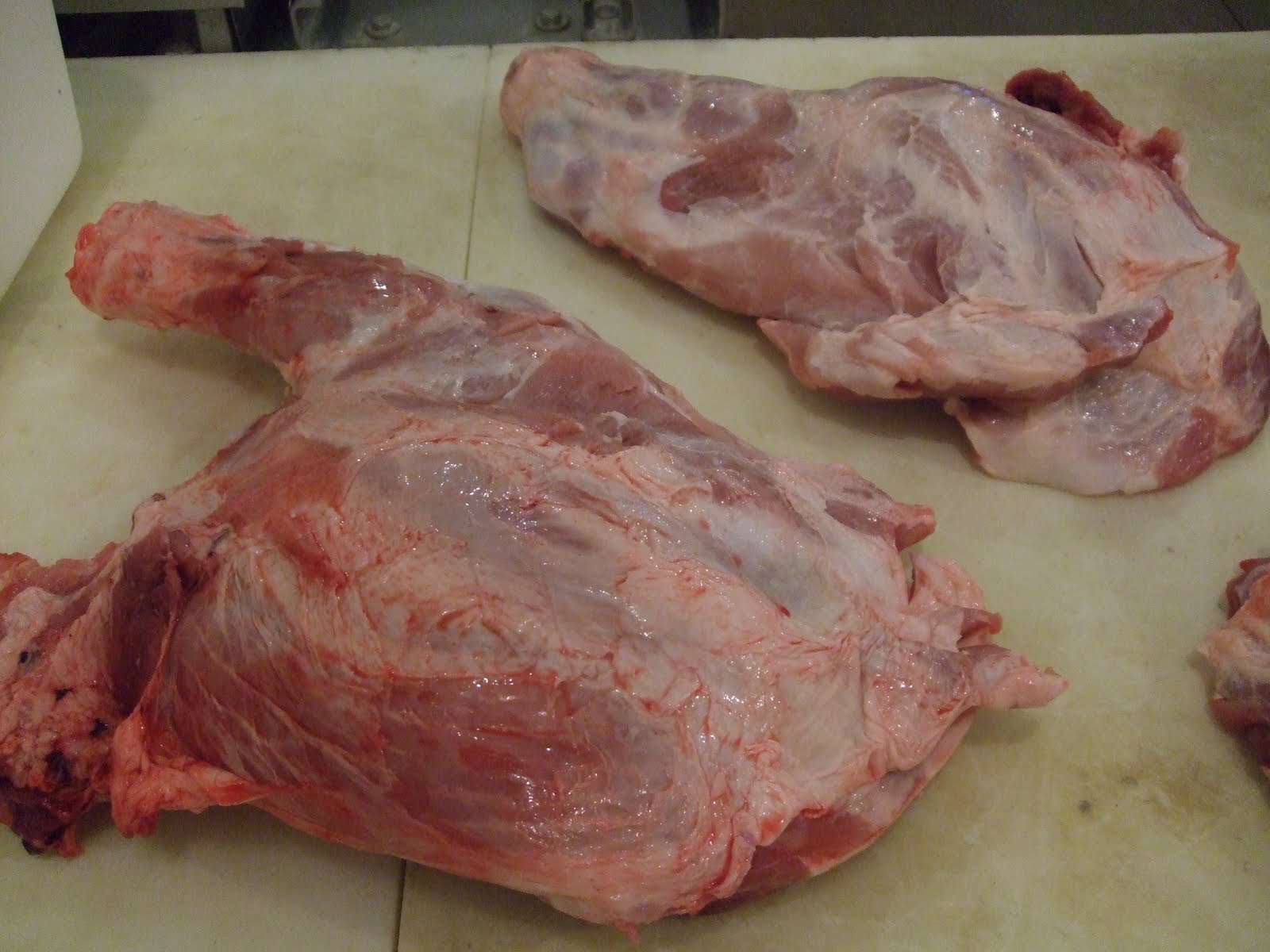
As you look at the picture, the front legs are in the far back, then the loin, neck & rib cage, and back legs. In the far right corner is the bandsaw that is used to cut the meat. Running a bandsaw is one of my great pleasures in life! I enjoy the process of breaking down the carcass into delicious cuts! Admittedly, I am much slower on the bandsaw than some butchers, but I have been very fortunate never to cut myself while operating it.
There is an old joke in the meat processing world: Hold up two fingers and ask "What's this?" It's a butcher ordering 4 beers! Slaughterhouse humor helps to alleviate the seriousness of the cycle of life & death colliding with the extreme potential for injury around dangerous equipment . . .
Friday, August 12, 2011
What I Learned from the Slaughterhouse
Here is my equivalent of a glamour shot: hair pulled back under a bandana, big yellow butcher apron covering my clothes, a knife in one hand, and an animal foot in the other!
When I first started working at the slaughterhouse, it took me some time to become used to the process. I have always been on the carnivorous side of the omnivore lifestyle, and I have always held a firm belief in the circle of life. Despite this, it does take an adjustment to be able to handle the reality of working in a slaughterhouse. For the first year that I was there, I observed the kill floor, but did not participate much in the process. Eventually, there was a day that our Christian employee was unexpectedly unable to be at work. We had both Muslim & Christian customers, and our goal was to serve their religious & cultural needs for their food products. Thus, I had to step up and perform the Christian kills to suit the needs of the Ethiopians & Eritreans that were purchasing animals that day.
I had observed the kill completed on an animal hundreds of times by that point, but I do vividly recall doing it myself for the first time. Mohamed held the sheep down to ensure the animal did not struggle, and to keep me safe as well (after all, a 200 pound ewe has the weight advantage on me!) I followed the procedure I had been taught: one stroke of the blade with a sure hand to sever both the carotid and the jugular as quickly as possible. I stepped back from the large sheep, as Mohamed held the animal to allow it to bleed out rapidly. I can remember with clarity standing there with the knife in my hand, and letting the impact sink in. For the first time, I felt that I was really taking ownership of my position at the slaughterhouse. If I was going to be the general manager, if I was going to be an advocate for local meats, if I was going to promote animal agriculture -- then I needed to be a part of EVERY step of the process.
From that day on, I made it my responsibility to learn every step of the process. I was already the "staff expert" on stomach cleaning, but I worked to learn the appropriate skinning process as well. Some things I was skilled at (bandsaw, you are mine!), and other things I struggled with (I can wrestle 120-140 pound lambs out of a pen . . . but I would rather not!) One part I always enjoyed was the evisceration process. I am fascinated by the anatomy of the animal and how each part of the body functions. In the picture above, the pig carcass has been skinned & washed. The next step was to open the mid-section, to remove the stomach, intestines, and internal items.
By working with the inside of the animal, I have learned a great deal about taking care of the outside of the animal. Intestines that split apart when you try to clean them? Parasite overload! That goat needed a good de-wormer. Lungs that are hard & purple? Pneumonia. Livers with hard spots? Possible parasites . . . must trim these off before releasing to the customer. We would even see bizarre things, like the goat that had testicles AND ovaries. The thousands of animals that I opened up taught me numerous lessons to make me a better farmer.
Slaughter isn't glamorous, but it is a part of the process of raising & enjoying food! The more we share with the public about what we do, the better educated they will be to make their own decisions on food. Besides, who doesn't enjoy a good slaughterhouse story?!?
Thursday, August 4, 2011
Hog Skinning -- or Adventures on the Kill Floor
In a slaughterhouse, the area where an animal is bled out and skinned is known by the very fancy name of "kill floor". Many slaughterhouses that do a large number of hogs will have a unit that dips the hog carcass in scalding hot water. The hairs on the hide can then be scraped off or tumbled off. Some cultures even prefer their goats to be done in this manner. This leaves the skin on, much like a chicken would be prepared.With my hogs, I chose to skin them. I relied on my student assistant/adopted son Big Al to aid me in removing the skin. We placed the pigs in a "cradle", which holds them elevated on their backs. This allowed us to take the hide off the legs, and reflect the hide off of the stomach region. From there, we raised the pigs up on a hoist to allow us to cut the hide off the back. The next step is hanging the carcass on a "gambrel": a large hanger that holds the animal during evisceration.
Wednesday, July 27, 2011
Yes -- That is a Dead Pig, and No -- You Should Not Be Offended!
Yes, you are seeing what you think you are seeing: that is me on the kill floor with one of my pigs. And I am definitely giving a thumbs up! This is an exciting point in the process of raising animals. You could certainly look at this photo and think, "Gross! Dead pig!" Think, however, about what this picture means to me: it is the conclusion of months of hard work to raise healthy animals, and it is the start of the process that means my family will be well-fed this year. One of the reasons that I always use the word "slaughter" instead of "harvest" is because I absolutely feel that raising & processing food is a noble endeavor. Yes, it is messy, but it is ethical. I will not shy away from the truth of this, and I think the public would feel better about food production if they understood the process. Consumers are smart -- open the doors and educate them! So, yes, this is my way of bringing you face to face (literally) with hog slaughter . . . because I think you are smart enough to be interested and to learn!Let me introduce you to my pigs. I got them a few months ago when they were a little over 100 pounds, and since then I have purchased A LOT of hog feed for them! (They were also amazing at cleaning up leftovers from the kitchen!) The female was curious and often romped in the yard. Sometimes these romps were Goatherd-approved . . . and other times they were not. Ever awoken at 1:00am because your puppies are going ballistic, only to discover that your pig has busted out part of the barn wall & escaped? Not fun! The male was extraordinarily lazy. He would lay around all day, and only get up when he saw me approach with food. He would waddle a few steps over to the feed, take a handful of bites, and then lay down with his head in the bowl to continue eating!
I have fond memories of these pigs. They received great care and attention. They grew very large (250-300 pounds) and could be difficult at times. Their destiny was to feed my family. In the days leading up to the intended slaughter date, I will admit that I was sorry our time together was drawing to a close. I knew, however, that I did not have the facilities to keep them for an extended amount of time, I did not have the extra money to feed extremely large pigs, and the natural circle of life dictated their role on the food chain. It is very important to me that animals are treated well in life and shown respect in death. Each time I have raised pigs, however, I forget just how hard it is to load them in a trailer from my barn. Thus, by the time I struggle and struggle to get them to the slaughterhouse, I am ready to say goodbye!
I owe a great deal of thanks to my friends Angie & TEC, who assisted me by offering their trailer for transport. My adopted son/student assistant Big Al served as my trusty right hand during the slaughter process. My amazing baby brother was right there with his gun to quickly dispatch the pigs. I am very appreciative that my step-father allowed me to utilize his facility for the butchering. I truly have a great farm family supporting me!
I am often asked about the slaughter process. As mentioned, we used a gunshot to the head to stun the pigs. My brother did this, then Big Al stepped in quickly to bleed the pigs. He used a very sharp knife to sever both the caratoid and jugular in one rapid stroke. This immediately shut down the neuro-sensory system, and the pigs bled out in a very short period of time. As the farmer who adored these hogs, I am comfortable with this process. It is quick, it is humane, and it is sanitary. Once the pigs bled out, they were placed in cradles to be skinned. I will post some more photos, as I believe that people are truly interested in how their food is prepared!
I love raising animals and I adore eating meat! I am proud to be a butcher, and this work has only increased my respect for life. If we accept that death is a reality and show respect for the process of dying, I believe that we will become more cognizant of the value of life. Life is beautiful, and death is a part of that journey. Farmers endeavor to raise their animals well, and provide humane slaughter options to produce the products we use. Learning more about food production is a good thing for our consumers!
Tuesday, July 26, 2011
I Want You to Know Mohamed
Mohamed always managed to catch my attention with his interesting perspective on the world. This was influenced by his life experience. Mo grew up in Mogadishu, and spent his youth during the turbulent years of the 1990s. As a teenager, he & some other boys were playing with a rocket launcher. Yes, it really was common for such weapons to be accessed by children in Somalia. The rocket launcher strafed Mohamed's face. He lost an eye and suffered some minor brain damage. Mohamed was eventually able to come to America, and I have never heard him say anything but good about this country. He is now married with four children, and he is delighted to raise them in an environment so different from his own childhood.
Every once in a while, I would find myself conversing with Mo and then catching myself when I realized how different our experiences have been. When Mo was still new to the slaughterhouse, I tried to explain to him how to handle the stomachs on inspection day. Since the lamb & goat stomachs were condemned under inspected slaughter, they ended up in our inedible barrels. During the summer, the gasses in the stomachs would expand, so each stomach needed to be slit to allow the gas to escape. As I described this to Mohamed, he tried to confirm his understanding of the expansion problem by comparing it to the human bodies he would observe lying by the road back home in Somalia. Wow . . .
After spending five years working with Somalis, marketing products to them, and preparing their meats, I feel a deep bond to the Somali community -- and especially to my Somali staff members. Somalia has experienced so much turbulence, and now it is being wracked by a horrific famine. This evening on the news, there was terrible footage of the starving children. It tore up my heart to see little ones literally starving to death, mothers mourning their children, aid workers frustrated by the lack of resources. I know this touches me especially, because when I see the proud Somali faces, I think of my staff, my customers, my friends.
I want you to know about Mohamed. I want you to know about the starving children of Somalia. And I want you to think about them the next time you hear of genetically-modified crops. Too often, scientific advances in agriculture have been pronounced "franken-food" in the media. It is absolutely true that science is being applied to advance agriculture. To me, this is a golden opportunity! Research is being done to develop new varieties of crops (such as corn) that can grow in areas with less rain -- like Somalia! Before you condemn the combination of science & food production, think about the dying children of Somalia. Consider how their mothers would rejoice if crops were more readily available in their region to feed their children. Ask yourself what you would do if your baby was wasting away before your own eyes . . .
While I tend to choose numerous organic products, I recognize how fortunate I am to have the freedom, the access, and the resources to choose these products. I have so much respect for individuals like Mohamed who have come to a new country to build a better life. The Somalis in our country are grateful for the American food system that provides safe, quality, affordable products. We need to be responsive to food policies that help feed the world. We must consider the advances that will be required to provide food internationally. These same advances could even create jobs for farmers in other nations! Science has helped to cure diseases, advance communication, and send humans to space . . . science can even help farmers to conquer starvation! Before you condemn genetic research in agriculture, consider Mohamed. Consider his countrymen. Consider what you would do to feed your own child.
Wednesday, June 22, 2011
Support Horse Welfare -- Support Horse Slaughter!
The picture above is of my beloved Lassy. My mother had always wanted a good Quarter Horse (so named because they are the fastest horse in the quarter mile) to take West to ride in the Rocky Mountains. Pine Raider's Lassy -- her registered name -- was born in 1978 and came to live with us in 1980. I was 4 and she was 2, so we basically grew up together! My mother rode Lassy all over the country and as I got older I also rode Lassy quite a bit. Eventually, as a teenager, I got my "own" horse: Tewanna. This wonderful mare passed of old age (approx 36!) while I was living in Washington DC. When I returned to Ohio, Lassy & Abe the Mule eventually came to live with me at Harrison Farm. I was the official "retirement home" for my mother's older equine!
By the time my mother passed on, Lassy & Abe were both getting up in years. This picture of Lassy with my godmother & friends was taken in September of 2009. Lassy was 31 then, and was no longer the gorgeous, noble horse who had once thundered along the mountain trails. Instead, Lassy was slower, a bit grumpier, but still quite loving toward me (if not Abe the Mule!). In August of 2010, Lassy passed quite suddenly. There was no lingering illness, simply a quick death from old age. I miss her, and especially missed losing that tie to my mother. At the same time, her death did lift a burden from my finances. In order to keep Lassy as healthy as possible, I was spending a great deal of money on a special feed for her. Even with this measure, she was still quite thin -- simply as a result of age. I do not regret spending that money whatsoever, but I did have to give up things I needed (goodbye health insurance!) at the same time I was making this purchase.
I wonder what I would have done if I was in a different situation. When I experienced a major job change and resulting financial strain in 2010, I was fortunate enough to have a roof over my head, supportive family & friends, and plenty of goats I could eat! But what about those who don't have my resources? If a single parent loses their job, has four children to feed, a mortgage to pay, and a car payment to keep up to date -- do they keep buying expensive grain for a high-maintenance horse? Beyond that, is it wrong for our society to expect them to do so . . . with the possible situation of children suffering as a result? I would resoundingly answer: YES! Sadly, few options exist for a horse owner in this situation.
Prior to 2007, three horse slaughter plants operated in the United States. Horsemeat was processed for sale to overseas markets (where it is commonly eaten) and for zoos & other wild animal facilities. This provided numerous positives: unwanted/untrainable horses had value because they could be sold for slaughter, they were processed in American facilities with inspectors on hand to ensure a humane end to their life, American jobs were created & product was sold overseas that added to our American Gross Domestic Product, and the horse industry could rely on the fact that every animal had economic potential. Due to Congress no longer authorizing federal funds to pay inspectors at USDA plants for horse slaughter, combined with the closure of the three existing plants due to state lawsuits in TX & IL, horse slaughter ceased in the U.S. in 2007. Since then the horse industry and horses have suffered.
A few months ago, the U.S. Senate requested that the General Accounting Office (GAO) issue a report on the unintended consequences of ending horse slaughter in our country. I have pored over the document, and found that my observations have now been documented through this comprehensive study. Jobs HAVE been lost. Revenue HAS decreased. Horses ARE suffering. The equine industry IS reeling. The worst part to me is the documentation that removing slaughter has created an increase in incidents of mistreated horses. There is no longer an option to sell your horse, thus the value is gone during a time when Americans are struggling economically. Do you feed your child or your horse? Many horses are being abandoned on public lands: state parks, federal forests, etc. This creates suffering for domesticated horses that are not used to a wild mustang lifestyle. There is not enough food on these lands for abandoned horses, thus it becomes the burden of the taxpayer to fund state governments & federal agencies to deal with these animals.
Admittedly, animal rights groups (including HSUS), maintain in the GAO study that the end of horse slaughter has NOTHING to do with the dramatic increase since 2007 of 1)abandoned horses, 2)shipment of horses to Canada & Mexico for slaughter, and 3)reports of mistreated or malnourished horses. It is baffling to me that anyone could look at the rise in these three statistics since the key year when horse slaughter ceased in the U.S. and profess there is NO connection. Unless, of course, they had another agenda in mind . . .
As humans we must guarantee animals are treated humanely in life & death. The United States has excellent inspected slaughter facilities that work to produce quality products. There is a strong market for a product we have in abundance at a time when we need jobs in our country. Horse meat is full of protein and there are people who are starving in our world. Let's tell our Senators & Congressmen to bring back horse slaughter . . . and make sure that all horses have value & humane treatment!
Subscribe to:
Posts (Atom)